Monday, June 27, 2016

Week 6 Getting a job

If I can only get that interview . . .
We all know that the job market is tight these days not only for reason of the economy but because there are so many people in the marketplace with varying skills, backgrounds and experience  People with 20 years of experience are competing for positions with new college graduates. For both candidates the first task is to be able to talk about your qualification in such a way that will get you that interview.
What does it mean to tailor employment documents?
Employment documents include resumes, cover letters, and any business message that concerns employment. Your message will be directed to your contact(s) in the organization and will vary depending on what your intent is upon writing. Regardless of the type of message, it is very important to make sure that you use a writing strategy that will effectively reach your reader.
In any piece of writing it is important to keep your audience in mind. Ask yourself, who will read my document? When you tailor a document to a particular audience, you are adapting your writing for a reader. It is important to consider what you want your message to convey to the audience.
Why is it important for me to tailor my employment documents?
It is important to tailor your employment documents for a specific audience in order to convey your message clearly and convincingly. Considering your audience will help you to personalize the document and make it relevant to the reader. If you write without a specific audience in mind, the document might be far too general and vague, or it might include too much information. When you tailor a document to a specific audience, the document will have better "unity of purpose and style," and it will make the reader feel more involved (Hale).
Audience is important for all pieces of writing, and even more so for any employment document because employment documents must be able to persuade the reader that what you are saying is true in order to be effective. You are directly communicating with the organization, and you want the reader to understand your message and its relevance.
For what types of readers should I tailor my employment documents?
There are two kinds of readers that an employment document should be tailored for:
Skimmers and Skeptics.
Skimmers are readers that are typically very busy. Pressed for time, they often skim employment documents in a rather short period of time. Consequently, the documents you prepare for this particular reader should:
  • State the main point clearly and up front
  • Place the most important information at the beginning or ending of paragraphs
  • Highlight key dates or figures
Both of the following examples represent the same experiences. A skimmer would be able to understand Example 2 much more quickly, though. Remember we have talked about how people read with an intent to "get it" quickly and with little effort.
Example 1
Managed $10,000 in project accounts, compiled and published engineering reports as assistant to Vice President, coordinated registrations, payments, and literature for software training seminars.
Example 2
  • Managed $10,000 in project accounts.
  • Compiled and published engineering reports as Assistant to Vice President
  • Coordinated registrations, payments, and literature for software training seminars.
The second type of reader is a Skeptic. A Skeptic is a reader that is cautious and doubtful. Skeptical readers will tend to read a document carefully, questioning its validity. Ultimately, they will question the writer's claims. In order to meet the needs of the Skeptic, it is necessary to support your statements with sufficient details and evidence. Provide specific examples, numbers, dates, names, and percentages to meet the needs of the skeptical reader.
For example:
NOT: I performed very well in my classes.
BUT: I received the Dean's List Honors 7/8 semesters and received a Women in Communications Scholarship in May 2001.

Why Make an E-Portfolio
“E-Portfolios or personal websites provide students the opportunities to showcase their best work and demonstrate in meaningful ways what skills and knowledge they can bring to potential organizations. The electronic identity adds another dimension to the resume and cover letter because it contains tangible examples that potential employers can see.

Where do you start?
It’s simple; you start by compiling your most impressive work. Pick work that really exemplifies who YOU are as a candidate for a job. Make sure to include a few key sections in your portfolio, like the following:
About me
Resume
Professional work (including relevant projects, responsibilities, and promotions)
Academic work (including course work, conference presentations, and published work)
Contact information
No matter what kind of job you’re interested in, you need to remember that this ePortfolio is an extension of your resume, meaning that it is not a static product. Each time you accomplish something that could further your job search prospects, you should update your ePortfolio.
What about all of my other stuff?
Use your portfolio like a hub of your information. LinkedIn, for example, on its own is not a portfolio; however, LinkedIn is very important in your job search.  Every student should have a LinkedIn profile. LinkedIn allows you to upload slideshows and video, but it does not have the flexibility of an e-Portfolio website.  Don't think of it as an either/or situation; every student should have a LinkedIn profile and include the address in your e-Portfolio website, as well as on your resume and business card.
Here are some examples from other school from graduating students:
Plus there is other stuff like


Your Name
Address
Cell Phone
Email
Education
  • College (anticipated graduation date)
    • Major/Minor
Skills
  • Technical and/or software skills
  • Microsoft Word
  • Final Cut Pro
  • Microsoft Access
  • HTML
  • SAP Business Objects
  • Quark
  • Adobe Photoshop
Experience
WalMart (Pittsburgh, PA 2007-2009)
  • Developed customer service manual
  • Reorganized toy department
  • Salesperson of the month three times (Jan. 07, March 08, Dec 09)
The ‘Doah newspaper (Winchester, VA 2008)
  • Wrote stories for multimedia site
  • Edited contributor content
  • Edited HTML for site


  1. Address the letter to a specific person rather than to a title.
  2. Use a stronger, more dynamic opening that grabs the reader’s attention.
  3. Avoid repeating information that already appears in your resume. Do not list work experience without specifically addressing how it relates to the position for which you are applying.
  4. Avoid using too many “I”s. The cover letter should be more about what the reader
  5. Never say anything negative in a cover letter. It flags you as a potentially difficult employee.
  6. Do not mention any inside contacts unless they can help you get the job. Be more specific about what you like about the company to which you are applying.
  7. Do not make salary demands or give salary expectations unless specifically requested to provide them. A cover letter is generally not the proper place to address salary concerns.
  8. Promise to make a follow-up call yourself.
  9. Avoid boring closing statements.
Use active verbs
Show off your skills until you get more experience
Have a separate sheet for your references
  •  Name
  •  Title
  • Address
  • Cell phone
  • Email

Don’t give it all away in your resume. Save some of yourself for your cover letter and interview.

Sunday, June 19, 2016

Week 5 plus Week 4 Supplement on Facebook

What is social media for business? 

Any website or mobile phone function that allows you to share content and ideas with other people. Just think of it as a variety of methods for getting in touch with like minded people from all over the world. There are hundreds of social media sites but the most popular site function as explained below:
This is funny but important because it helps you think about how to USE each of these sites to get to: 
Customers
Employees
Shareholders
Media

And with these are also getting responses from these audiences in real time. In many companies there are people whose sole job is to respond to people online.


Let's start with Facebook. Take a look at these corporate Facebook pages: 
  • https://www.facebook.com/porsche
  • https://www.facebook.com/NHL
  • https://www.facebook.com/Mabelhood
  • https://www.facebook.com/burtsbees
  • https://www.facebook.com/Starbucks
  • https://www.facebook.com/smartpassiveincome (this is a single person business perfect for the entrepreneurial types) 
Don't think about personal pages but what works here as a business. Take a look at how they are interaction with customers. These are considered the best companies that use Facebook as a way to interact with thier customers. How are they doing it? Take good notes and look at all six of these pages - What do they have in common? What is different? What do you find to be the most compelling content (Even if you are not interested in cars or coffee look for what good companies do - that is your job as a professional.)

Twitter

Do you have a twitter account? If you don't you should. Don't think if it as a declaration of "I'm eating a # donut" but use it as a tool to keep with with your industry and your target audiences. many use Twitter, like Facebook, as part of their overall social visibility. 

 You can also use it personally make contacts with possible customers, to see what the competition is doing and for getting creative by seeing what others are working on and suggesting. The Huffington Post offers the following list of companies and individuals to follow in the Twitter-verse. Take a look. Choose a few you think are relevant to you. 


Top 100 Business, Leadership and Technology Twitter Accounts You Must Follow


You Tube 

As students you spend a lot of time on You Tube watching cats, looking at music videos and watching your peers do really stupid things. You can also use it for your business. Watch this and understand what works:

http://www.youtube.com/bestbuy

http://www.youtube.com/allstate
http://www.youtube.com/KraftCookingSchool
and the genius http://www.youtube.com/Blendtec (I happen to love this video series - watch several of these. They will make you laugh.)

Again watch these and take notes about what works (you need all of this information for the assignment below)


It is important to study this stuff but it is also important not to get distracted. You are trying to grow a business not your social media accounts.

There are here also dangers when getting involved in the social media labyrinth.

1. People are critical of bad products
Well, lets be honest. People are always critical of bad products its just that now they can talk about them on Twitter.
If you provide a bad service or product you can be you will be flamed (chastised) on Twitter. Be ready for it.
The thing to realize here is that those people are already talking about you. It is therefore extremely important to get on and start talking to them, helping them and addressing their concerns.
2. Bad timing and poor planing can be deadly
A few months ago QANTAS, Australia’s national airline, grounded all its flights around the world due to ongoing industrial action. It left thousands of people stranded across the globe and a media storm unlike I have ever seen in Australia lasted for weeks.
Many people were angry at the CEO’s decision to ground the fleet, while others thought he had no other option and did the right thing.
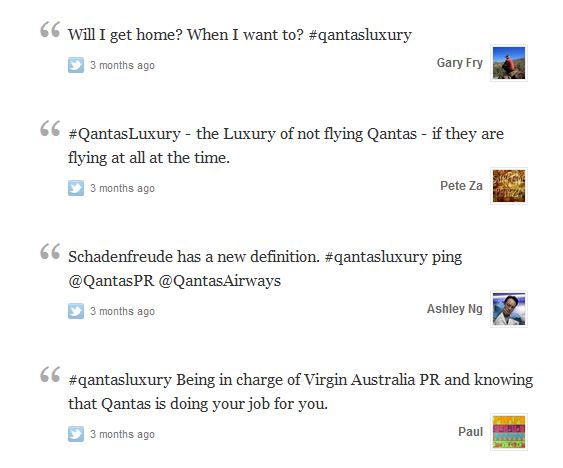
Shortly after this massive event (and a lot of negative PR) QANTAS launched a Twitter campaign with the hashtag #QantasLuxury saying:
To enter tell us ‘What is your dream luxury inflight experience? (Be creative!) Answer must include #QantasLuxury.”
Bad idea.
Qantas Twitter mistake
A few of the resulting Tweets from QANTAS’ Twitter competition.
Now, in case you don’t know, a Twitter hashtag is something you use when you want everyone involved to be reading the same thing. For example, you’ll often see hashtags about sporting events like the Super Bowl because the promoters want to get people talking in the same place.
And thanks to a website called Storify we can see a record of all thee nasty, mean and hilarious replies that QANTAS got as entries into this competition.
This is an extreme example of what can happen with bad timing and a poorly thought out campaign. This Twitter competition might have worked wonders if goodwill towards the company was not at such a temporary low (QANTAS is normally a much-loved Australian brand).

The Assignment

Look at all of the examples - the good and bad of using social media. 

Write a memo outlining what we should be doing with our cooperate social media. Use the memo format and tell me what you have learned and how you think we should apply it to our business. It is important that you explain WHY you are making these suggestions about our social media. This will be due Monday, June 27 by noon. Remember this memo should only be one page. Use bullet points and have links to things that you would like your CEO (me) to see. 


To help you come up with some interesting ideas I will tell you what kind of widgets that we make - we make sunglasses. 


Tuesday, May 31, 2016

Week 2 - Emails and Memos: The bulk of your professional communication

Welcome to Week 2 - Emails and Memos

This week we were going to work on writing issues in the workplace and proper writing style. Go to our Google Drive and take a look at the PDF book chapter I have copied for you. You do not need to read the entire chapter (We must learn to skim.) Read the pages devoted to proper email style and proper memo style.

Follow the basic templates for each of these documents. Don't make more work for yourself than need be; follow the templates so that you may spend more time concerned with your words. These are not long documents so you have "space" to make them flawless.

The details: The email

We will function like a small business in this class. The name of our company is Crowley Widgets International. When you correspond with me I am always the CEO of your company. Whenever you send me a document write it as such unless I indicate otherwise. 

By noon on Monday, June 6  send an email  to my SU email account. 
The email will be about the company that wants to win our advertising business.  The first email is to give me a preview  of the meetings you are attending with both agencies. Spend most of your time for writing the email on the book chapter I have in the Week 2 Drive. You will use the information from the video posted in Google Drive for Week 2. 

The details: The memo.

The memo will contain details about your chosen agency after their presentations. This will be your suggestion as to which agency you think is best for our company and why.  Send the memo in an email (that is also a part of the grade because you have learned to send one well) to my SU account on Tuesday, June 7 by noon. Several things to consider when writing a memo:

TO:

FROM:

DATE:

RE: (In reference to . . . )

The introduction
Remind me (because I am very busy) of the discussion we had about looking for a new agency to partner with. Always begin a memo giving the content structure and context. Tell me what we are going to be talking about and what conclusion you came to; don’t make it a secret until the end.

Start with the main idea
Begin by outlining which agency you chose and a little background about them. (You may have to do some outside research other than watching the program.)

State the major points
Remember what it is that your agency does (We make widgets for and come up with a list of 3-5 points where you think this agency could help our marketing team.

Illustrate with evidence
Once you make those points, based on what you watched and researched, give evidence as to why you think this agency should work with us.
Almost as important as the actual content how you structure your content visually.

Use headers and bold them.
Headers help the reader can scan the document more easily.

Also use bullets:
Don't have too many items. Three is good, four OK, five manageable (if you're lucky), more than five you should think again!
  • Avoid making bullets as long as paragraphs.Three lines is a reasonable maximum length.
  • Be sure bullet points are related, especially if you have more than five.
  • If you have many points break them up for clarity.
  • Avoid bullet points when you want to build rapport or deal with sensitive issues. Bullets communicate efficiency rather than warmth.


When you conclude your memo always end it with some sort of action point.

“Would you like me to set up a meeting with the BLAH agency?” or “Would you like me to acquire an RFP?”

Also give the person you are sending the memo to a time frame in which to reply.
“Please let me know by Wednesday, March 23 so that new business group can create an agenda for the next quarter.”

Best,
You


Let's look at a couple of examples:


This document should not be more than one and one half pages but a single page would be ideal.  If you have any questions you can email me. 

Be prudent, be creative and most of all be confident in your ideas.

I look forward to reading the memos and your suggestions for our company.

Monday, May 23, 2016

Thinking about communicating and the assignments Week 1

Hello, communicators.
I'm excited to be working online with you. I think this is appropriate space because we all work so much online. This is an important question in this short semester:

How do communicate with technology?

Popping off a quick email, posting a comment to an online chat or even writing something more complicated can often be misinterpreted through electronic communications. I am sure you can all think of incidences where you thought an email meant one thing but you didn't understand the tone of the message.

Electronic communication can also be difficult because your don't want to write too much (no one will read it all) and you don't want to write too little because you don't want to leave out details that are important.

So how do we reconcile

  • What we want to say
  • How we want to say it
  • Who we want to send it to and
  • By what kind of communication do you want to send it?

Read the article posted in our Google Drive and watch this talk given by the author Nicholas Carr.


I want you to be thoughtful about how you try to work with the computer - our third most important tool - next to our brains and our voices.

This week you will have two assignments.

ASSIGNMENT 1

By Friday this week - you will post on the Facebook page the following information:

Introduce yourself to the class and write about your writing issues on our Facebook page. What are your biggest writing and communication challenges? What do you like about writing and what so you hate about it? Again this will be a challenge because we don't write "papers" on Facebook.

Take some time and think about how you use these technologies and if you think they make you a better communicator.

Think about every word you choose and have a reason for it.

For example, the above sentence started out as "You should understand why you choose the words you choose." As I read it I realized several things:

Verb generally make the sentence stronger; I didn't do that.
I used too many words when only a few were important.
I didn't explain myself well.

Which sentence do you think is better? AND WHY?
I have my reasons; what are yours?

ASSIGENMENT 2

For next Monday write a short brief 400-500 words on the email you read, Facebook posts, blogs, chats, articles from the industry blog or news sites you read. This is about how you interact with professional information. Use the reading from Week 1 from Nicolas Carr and the video to help you be reflective about your communication techniques.

SIDE NOTE - THIS IS ABOUT YOUR PROFESSIONAL COMMUNICATION. If you are not reading, blogging, tweeting, sharing information about your industry of interest. GET ON IT!
Start reading or looking at the following:
WSJ
Marketplace
The Economist The smartest people in the world read this - be one of them.

In other words,
start to look at what you read
how it is written
how you react to it

Dig deep here. Don't just say, "I read the WSJ about manufacturing and all of the articles are well written. I understand and believe everything I read."

Think about the words. Think about a time when you experienced a miscommunication on an email or text. What was the problem and how did the problem resolve itself? Have you changed what you say in an email or text because of an incident?

Take some time and think about how you use these technologies and if you think they make you a better communicator.